Showing posts with label optics. Show all posts

Sunday, July 21, 2019

My Holosun HS507C is Dying/Dead

Okay, I guess I've joined the club.  My Holosun HS507C is failing me.  Yes, I knew going in that this was a possibility, but I didn't really think it would happen so soon.


I bought the Holosun from Aim Surplus on April 14th, with the intention of just trying out the slide-ride red dot concept.  I got about 425 rounds of 9mm fired before it started to shut itself off.  Today I took it out, and fired about three rounds, and then the reticle disappeared.  I can turn it back on, which puts it back into auto-brightness mode, which doesn't work well at all, and then a few rounds later it's turned off again.  It is rather hot today, but I know that hot for July in Pennsylvania only qualifies as "warm" for a place like Louisiana.

I have made no attempt to "torture test" the sight.  Never banged it against anything to rack the slide.  This is just 425 rounds of normal use with standard pressure 9mm.

Although changing settings is somewhat complicated with only two buttons, I like the Eotech-type reticle for this kind of application, and was enjoying using the sight.

I filed a warranty claim with Holosun on July 30th.  I haven't yet received any phone calls or emails yet.
EDIT: Received return label on August 7th
EDIT: Replacement sight shipped August 26th

Thursday, September 26, 2013

DSG Arms - Free EoTech with DD Rifles, Free Shipping

Screen Cap from DSG Arms e-mail

They're kind of expensive rifles, but good rifles aren't cheap, and these are good rifles.  When you add in the free EoTech sight, it's a pretty darn good deal.

DSG is pretty good for aluminum AR magazines and other gear, if you're like me and don't really need another AR, take advantage of the free shipping offer.  Coupon code "NOFREIGHT4YOU"

Friday, November 16, 2012

Review: Primary Arms Red Dot Sights

I bought a bunch of Primary Arms red dot sights when they ran a sale a few years ago.


Bright Enough
One of the biggest things to be careful of, when buying cheaper dot sights, is to make sure they are going to work in bright sunlight.  I sucks when you go out shooting with someone, and then you have to explain to them that you can't shoot now, because your dot isn't bright enough to see against the target.  What's worse is when you've traveled to a match, and paid your entry fee and then discover that your sight no worky.  Fortunately, the Primary Arms sights don't have that problem.  The dots in the PA sights can be made bright enough to work in bright daylight.

Blue Tint :(
When I took the M3 clone out of the box, and looked through it, the blue tint of the lenses was immediately noticeable.  I didn't immediately notice the tint with the Micro clones, but it is there, though not as bad as the M3 clone.

The blue tint of the M3 clone is not a deal-breaker, as far as I'm concerned, but it is sort of annoying.  The tint of the micros is barely unnoticeable

Battery Life
One of things you lose, over a real Aimpoint, is battery life.  An Aimpoint M2 will go about 3 years, left on, on a single battery.  The new Aimpoints with the ACET circuits are said to go 5 years.  The Primary Arms sights will not go nearly that long, but I have not personally measured battery life.

I left one of my micros left on for about 9 days with the battery that came with the sight.  When I went to pick up the rifle again, the battery was dead.  I replaced the battery with an Energizer.  I have since left it on for a few days, before realizing that I left it on, and that Energizer will still operates the sight just fine.  So battery life is good, but not as ridiculously long as the Aimpoints.

I don't think I've replaced the batteries in the M3 clones, though I don't use the uppers that they are mounted to as much as I use the uppers with the micros.  A little research shows owners of PA micros and M3 clones reporting about 200 hours battery life.

The M3 clones run on 357 button batteries (that's pretty easy to remember), and the Micros run on 2032 coin batteries (same as the Aimpoint Micros).  These batteries are easy to find and inexpensive at Wal-Mart, and if you are in a pinch, at drug stores and other places that sell electronics for about twice the price, maybe more.  Keep spares in your range bag, your pistol grip, vertical grip, or stock.

Primary Arms Micro QD Riser Mount
The PA micros, with detachable Picatinny mounts, should work with any mount that is made for an Aimpoint Micro.  There are some Primary Arms micros with built-in mounts though.  Primary Arms offers a QD mount high enough to co-witness with back-up or fixed sights on an AR-15, as long as you aren't using the Troy Micro BUIS made for the HK 416 uppers.


The sliding button that locks the lever in place has a stiff spring.  The locking lever itself is rather stiff to operate also.  It's not as good as the American Defense mount that I bought for the real Aimpoint T-1, but the Primary Arms mount is three-eighths the price of the AD mount, and less than a third the price of the Larue mount, so it's kind of hard to complain.  The PA riser mount works, and it's very inexpensive.  It's just not very slick, and it's made in China, or some such place, while most of the other more expensive options are made in America.

AK Platform Use
If you are going to mount a micro sight on an AK with an Ultimak gas tube or TWS Dogleg mount, and you want the micro and iron sights to co-witness, then you'll want one with the built-in mount (model MD-07), not a detachable mount (models MD-06, or MD-08).  The Primary Arms micro with detachable mount I have on the WASR-10 with Ultimak sits too high to co-witness.  The built-in mount would also probably be desirable for mounting on a pistol with a scope rail.  Primary Arms Blog: Why Three Versions of the Micro Sight?

The PA micro sight that I mounted on the Ultimak does get warm after shooting a few magazines through the rifle.  Although it did come loose, the heat doesn't seem to have done any harm to the sight.  I haven't bump-fired drum magazines, but everything seems to be good to go.

Micro Kill Flash
One option available from Primary Arms, but not available from Aimpoint is a micro red dot optic with a screw-in Kill Flash.  If you are not familiar, a Kill Flash is a honeycomb disk that hides the light from the LED emitter from everyone not looking directly through the tube.  Kind of silly, for something that's not really a combat optic, but I credit PA for innovation.

Primary Arms Micro Kill Flash

I tried taking the Kill Flash from my Aimpoint M2, and screwing it into the Primary Arms M3-clone.  The Primary Arms sight seems to be too small in diameter, and the castle nut holding in the front lens goes right up to the front edge of the tube anyway.  No go.

The Verdict
If you need a red dot optic for a plinker, or even a competition gun, definitely consider a Primary Arms sight.  Probably skip the Kill Flash though.

Besides the blue tint, there isn't really anything that I have to complain about.  I haven't had any mechanical or electronic issues.

Durability seems very good.  The lens covers on the M3-clones are holding up, which is surprising for "freebies," considering that I've had several sets just fall apart with normal use, including Butler Creek covers.    The bikini lens cover from one of the micros broke, but that sometimes happens with the Aimpoint Micro lens covers too.  If you look on YouTube, there is a video of a Primary Arms micro sight getting tossed around and dropped on the concrete pad of a shooting range, then picked up, and it's still working.  Placed back on the rifle, it's still holding zero.

97SVTVERT Torture Testing A Primary Arms Micro Sight

For a defensive firearm?  Well, they do hold a zero pretty well.  You can't leave them on, like you might with an Aimpoint, but if you have iron sights co-witnessed through the optic then you should be fine, just turn the sight on when you need it.  Maybe not optimal, but workable and a lot cheaper than an Aimpoint.  Don't spend ALL your money on optics, and not have money left over for ammo.  Live-fire practice is important to develop the software needed to be effective, don't skip it to buy better hardware that you don't really need.

I will also caution you not to buy cheap, and then ending up buying twice.  If you are going to end up with a quality optic eventually, consider holding off and saving your money.  I knew when I bought my Primary Arms sights that I could always put them on rimfires or airsoft guns.  The tan M4 in the photo above is actually an airsoft gun.  The AR upper with the M3-clone at the top of the group photo is a 9mm upper that I bought for practice at indoor pistol ranges, and that sight isn't going anywhere.

If you think the blue tint of the M3-clone might bother you, maybe check out a Vortex sight.

Friday, May 25, 2012

Finally Replaced Aimpont Battery

I bought a used Aimpoint M2 a few years ago for my LMT M4.  In September 2009, I replaced the battery that came in it with a new one.  I've left the Aimpoint on, turned to the 2nd highest setting, since then.  I just noticed last night that the dot wasn't as bright as it used to be.  The dot was still there. . . I just couldn't get full brightness out of it.

Aimpoint has upgraded the electronics in it's sights since they made my M2.  The new circuitry is supposed to make a battery last about 5 years.  I'm not going to rush to replace the "old" M2, as the battery only cost me a couple dollars a year, and the battery I put in I picked up from Amazon for just $4 shipped, a couple dollars cheaper.

Tuesday, December 6, 2011

Low-Power Variable Scope vs. Red Dot

Living Room Carpet Photo.  Sorry.  At least you can't see my Crocs in the bottom edge. ;)

The Millet DMS-1 is a pretty good scope, however, a low-power variable scope will never be quite as fast as a red dot at less than 25 yards.  I don’t think it’s a function of the quality of the lenses.  The DMS-1 seems to be really clear to me.  It’s just the nature of telescopic devices.

When you’re looking through the eyepiece, the image that you see is the image that the objective lens “sees” more than a foot out in front of your eye.  The image is translated through the lenses, and then through the couple inches that make up the eye relief.

With a red dot, except for maybe a little bit of tinting because of lens coatings, and a little bit of color in the glass, you can actually see the same image through both eyes.  This is very intuitive.  With a low-power variable scope, even if the scope isn’t magnifying the target, you’re still not seeing the same image with both eyes.

When you’re looking through the low-power scope, and one eye is seeing. . . what it usually sees, and the other eye is seeing an image that’s actually more than a foot in front of your face it’s disorienting.  It’s really disorienting if you’re moving, or tracking a moving target.

I was actually a little bit surprised to find that it’s a little easier to hit index cards out to 25 yards with a red dot with no magnification.  I’d have thought that there’d be enough precision required that magnification would help.  Nope.  Put dot on target, squeeze trigger is all you need to do.  Even I can do that offhand.

Now, those index cards get harder to hit when you get out to 50 yards.  With a steady position, or some support, I can still hit the cards consistently at 50.  A 4 MOA dot covers 2 inches at 50 yards.  It’s getting hard just to put the dot on the card.  With the DMS, I can encircle the card with the reticle and I can zoom in a bit, and still get hits from a sitting position without too much difficulty.

At 75 yards that dot is about the same width as the card, and I pretty much need a bench rest to hit that sucker with a 4 MOA red dot.  Turning the DMS up to 4X, I can still nail the card pretty much all the time from a sitting position.  From prone or a good supported position the index cards don’t stand a chance with the DMS on 4X.

At 100 yards, I can hit paper plates almost 100% from various offhand positions at 100 yards, with the red dot, but I can’t hardly see the index card (20/40 vision), and the dot would almost completely cover the whole index card.  Maybe half the rounds will hit an index card taped in the middle of the paper plate.  I can’t do much better with a benchrest, maybe 75% hit the index card.

At 100 yards though, I’ve shot 10-round groups approaching 1” with the DMS at 4X.  The scope is definitely better for real precision.

Why am I going to so much trouble to hit those damn cards?  They’re cheap, and are a pretty good representation of the brain of someone who’s looking, and shooting, at you.  If your opposition is smart, then all you’ll be able to see of them is the top half of their head.  The head of a USPSA target is about 6” square, with a brain box about 2 x 4”.  The head of the IDPA target is just a 6” square.  An index card is a pretty good ½ size approximation of the “A Zone” of the USPSA target (6 x 10”).

There is an alternative to a low-power variable scope.  You can run a red dot sight with a magnifier.  Most of the magnifiers are 3X, but I’ve also seen 4X and 5X magnifiers.  With a detachable magnifier mount or ring that allows you to flip the magnifier over to the side, you get the close-range speed of a red dot with most of the precision of a low-power scope. 

The drawback of running a red dot and a magnifier is cost.  A half-decent low-power variable scope with a quick detach mount will run maybe $350-400.  The Aimpoint Pro package of a red dot sight and basic mount runs $400, and I’m not sure if you can fit a magnifier mount in between that Aimpoint mount and a back-up-iron-sight (BUIS).  The less expensive but still decent quality magnifiers run $150-200, and only come with screw-clamp rings.  The Larue Pivot mount is the only one I can really recommend, aside from the one that comes with the $500 EOTECH magnifier package, and the Larue mount runs $150.  To fit an Aimpoint-type red dot, magnifier, and BUIS all on a flat-top AR-15 upper, I think you kind of need a cantilever mount for the red dot.  The Larue QD cantilever that I have my Aimpoint M2 in runs $165, but you can get by with the Primary Arms cantilever mount for $25.

I would have thought that the red dot/magnifier combo would weigh more than a low-power variable scope, but that doesn’t seem to be the case.  I weighed up some stuff, expecting the scope to come out lighter.
  • DMS-1 in American Defense Recon-X 30mm mount – 1 pound 9.6 oz.
  • Aimpoint M2 in Larue LT129 cantilever mount – 11.3 oz.
  • Vortex 3X magnifier in Larue LT649 Pivot mount – 12.2 oz.
  • Aimpoint, Vortex 3x, and Larue mounts all together – 1 pound 7.5 oz.
If you are running something other than an AR-15, SCAR, or ACR, you’re going to have some trouble running a red dot and a magnifier.  I haven’t seen any low-mount flip-to-side magnifier mounts, and the AR-15 mounts will be sort of silly high on an AK variant, HK, M1A, or FAL.  You can still use the AR mounts, but you’ll have to add a cheekpiece to your stock in order to get any kind of cheekweld.

I prefer to run a red dot/magnifier combination for an all-round carbine.  I can’t quite get the same long-range accuracy this way, because the 4 MOA dots of my Aimpoints cover more of the target than the small dot or crosshairs of a scope.  If I ever needed to do any fighting around here, it would mostly be inside of 100 yards though.  If I really needed to shed some weight, I could remove the magnifier from the rifle, and just put it back on as needed.

Millet DMS-1 Scope Review


I’ve been surprised by the accuracy I’ve gotten out of the DMS-1.  With handloads, I’ve gotten a bunch of 1 1/8” ten-shot groups from a free-floated LMT M4 16”, even with the 6 pound stock trigger.  It may actually do better, but the barrel might not be able to do any better than that.  I wouldn’t have thought that you could do even that at 100 yards with just 4X.

Does the 1 MOA dot hold back bullseye accuracy?  Maybe not.

At least to my eye, the glass is very clear, without much distortion.  I was a little bit afraid that the scope would not be too bright, with the small objective lens, but it is actually very bright.  It holds a zero well too.  Compared to the red dot magnifiers, the eye relief is pretty good – I don’t get bumped in the glasses as much.  The spare battery compartment in the turret cap is a nice touch.  The reticle is useful without being as cluttered as some ranging reticles. 

At least in daylight, the scope works fine without battery power.  The reticle is quite visible without illumination until dusk really sets in.  With the illumination, you can stretch your shooting out even after it gets dark. . . as long as you can still make out the target.  The illumination knob goes all the way around, so you can go straight from 0 to 11.  Yes, the DMS-1 actually goes up to 11!

A spare battery is stored in one of the adjustment knob caps.  1 click of the knob moves P.O.I. 1/2" at 100 yards.

Negative points?  At 18 ounces, it’s heavier than some comparable scopes - the Trijicon Accupoint 1-4x24 30mm scope only weighs 14.4 ounces.  If you want a bright reticle, like a red dot sight, in bright daylight, you will be disappointed, because the reticle will still just appear to be black.  The lens covers that came with the scope fell apart quickly (although the Butler Creek lens covers didn’t make it much longer).  With the magnification ring set at 1X, the scope actually seems to make objects appear smaller than with the naked eye – I seem to get true 1x with the magnification ring set at about 1.25X.  Makes me wonder what 4X really is.

I like the scope. . . for what it is.  Certainly, for the price, it is fantastic.  I’d just rather have an Aimpoint and a 3x magnifier.  You can read about the why of that in this article.

Sunday, September 18, 2011

Attero Arms AK Mount - $75, Co-Witness with Micro Red Dot

Picture "borrowed" from Attero Website - Hey, it's free advertising.

Hey, this is kind of neat.  For about $75, you get new iron sights with white dots, and a mount to fit a micro red dot.


There's two models.  The one pictured above is the "Alpha" model, and it fits the Burris Fastfire sights, Trijicon RMR, and other sights with the Doctor pattern mounting holes.  The Bravo model fits Aimpoint Micros and the Primary Arms Micro Dot.

Looking forward to hearing some range reports.

Tuesday, August 30, 2011

Aimpoint Micro T-1s Under $500

Midway is running a sale on the Aimpoint Micro T-1.  $499.99 without any mount, which won't be a problem for those that are going to buy a high mount for an AR anyway.  Use coupon code "182011" to get the sale price.

SWFA is running almost the same deal @ $498.95.

Sunday, June 26, 2011

TWS Gen.II AK Scope Mount


I finally got the Gen. II TWS scope mount and peep sight that I ordered from Dallas Shooting Supplies a few days after Christmas.  Harummph!!  It came in about the 20th of May.  I'm not exactly sure, because I wasn't home and they didn't supply a tracking number.  I believe that I got the latest version with the "spacer" for the .308 Saiga rifles.  My intention was to mount it on my Interarms Tantal (Polish AK-74, more or less, with some unique differences).

How Does It Work?
The TWS Gen. II scope mount is a railed dust cover.  Wait a minute, don't start groaning just yet, this one's pretty clever, and seems to work really well! 

The cover is held in place in front by a hinge pin that passes through the front of the mount, and the holes where the pin for the rear sight used to reside.  That pin fits tight too.  The tab that the hinge pin goes through is attached to the dust cover with two socket head screws.  The overall length of the TWS mount, from rear sight bracket to stock trunnion, can be adjusted with these two screws in order to help make the mount fit individual rifles.


A tab, bent in on the right side of the cover works as a spring to maintain the lateral alignment of the rail.

Top: Right, rear corner of TWS dust cover mount.  Bottom: Inside, rear of railed TWS dust cover.

An angled surface on the bottom edge of the take-down button supplied with the rail interacts with the cover, like a wedge, to hold the cover tight against the stock trunnion.  Recoil only helps to snug the mount down tighter.

Crude attempt to show the angle of the button on the TWS guide rod.

The TWS dust cover mount is held tight to the receiver every which way.  The barrel is press-fit and pinned into the barrel trunnion, which is firmly riveted to the receiver.  The rear sight and optic mounted on TWS mount should stay aligned with the barrel.

Compatibility
The TWS mount will fit most stamped and milled 5.45mm, 7.62x39mm, 7.62x51mm (Saiga), and .223Rem AK variants.  It will not fit Yugo's, because their dust covers are half an inch shorter than most AKs.  It will not fit Saiga shotguns, because the shotguns have different barrel trunnions and rear sights.

It doesn't attach to the tang of stock trunnion, so it will work with AK pistols, underfolders, and rifles with side-folding stocks.

I believe there are plans for a Yugo version.

Return-To-Zero

The TWS mount is supposed to hold a zero, and return to zero even after you flip it up and lock it back down, through the simple machine elements described above.  For the most part, it does.  After sighting in, I flipped the mount/dust cover up, and unseated the take-down button/recoil spring guide, and then I buttoned everything back up again and vigorously racked the bolt carrier a few times.  I did this return-to-zero test a couple of times.  The first 2 or three shots would go a little bit to the right before the recoiling bolt carrier fully seated the take-down button/recoil spring guide against the rear of the dust cover/mount.  After those first few rounds, the bullets would start going through into 10-ring again.  At 12 paces the difference was maybe half an inch for the 1st round.  I can live with that.

This testing was done without fitting the recoil spring guide to the stock trunnion.  Return-to-zero may be better now that it’s fitted -- more on this when I get to installation.

First Impressions
Initial inspection was very positive.  I was happy to see that the font size of the engraving was not as large as on some of the prototype and beta-test mounts.  I also was a little surprised at how nice the mount looked.  I wasn't sure exactly what I'd get from a small company.  The mount looks very nice, and there's no machining marks on the outside of the unit.  Every other slot in the rail has a number machined (maybe laser engraved?) on it.  I'm very pleased. 

Please note that my Interarms Tantal has a grey finish.  Keep that in mind as you look at the picture of the mount on my rifle.  The grey rifle finish is the oddball, not the finish on the TWS mount.  I actually really like the grey/black two-tone look. . . I just need Duracoat the silver Aimpoint.

Installation
The mount didn't come with any instructions.  Having read through the ak47.net forum thread, and seen a YouTube video on how to remove an AK rear sight, I knew what I had to do.  That TWS Gen. II Scope Mount thread currently stands at 69 pages, and it's still going.  The mount should come with an instruction sheet, it's not a simple drop-in/bolt-on installation.  I was able to get the mount installed in 25-30 minutes, with a lot of that time spent fighting to get the hinge pin installed against the sight spring pressure.  Like I said, the pin fits tightly, and forcing everything into place took some real effort.  Removing the rear sight from my rifle was not as easy as shown in the video either, so that took maybe 3-5 minutes, instead of about 2 seconds as shown.  Getting the recoil spring removed from the Tantal take-down button/recoil spring guide, and reinstalled on the button/guide supplied with the mount was easier than I had expected, but remember, there were no instructions included, and I was working on prior knowledge from reading 50+ pages of forum posts.  Without knowing what to do, it would have taken a whole lot longer.

I did get the mount installed on the Tantal without cutting or filing anything.  It should be noted however, that fitting the TWS recoil spring guide may be necessary or even required in some cases.  The Gen.II mount worked pretty well on my rifle with no modification, but I don’t think stoning/filing the bottom of the TWS recoil spring guide hurts anything, and I’ll feel better knowing that there’s nothing to keep the mount from locking down snug.

Stock TWS spring guide.  Note that both screws are showing.

Romanian Spring Guide.  See how far back it goes?

TWS spring guide with the bottom filed/stoned down some. Note only one screw fully exposed now.

Co-Witness
The rail sits very low, allowing some micro red dot sights to co-witness with the iron sights if you get the TWS peep sight.  With a real Aimpoint Micro, the iron sights show in the lower 1/4 of the tube.  Heights of the tubes of the Aimpoint micro clones often sit higher up and may not allow co-witnessing with the iron sights.  By all accounts the Bushnell TRS-25 micro red dot sight will co-witness, and runs $75-90 some places.  The Primary Arms Gen.7 Red Dot, with the non-removable mount, may also co-witness, but the TRS-25 seems to be more common on the TWS Gen.II Mount.  The Primary Arms Micros that I have, have the detachable mounts, and the bottom of the tube and dot emitter block the iron sights.

Putting the rail on top of the dust cover gets the rail very nearly as low as on an Ultimak Scout Mount.  It is lower than the other Beryl-type rails made by Kreb's ($300!?!?), DPH Arms, UTG, or Red Star Arms.

Balance
The TWS rail doesn't add any more weight up front, like a 3 or 4 rail handguard.  Think about it.  Almost all the weight of an AK is forward of the pistol grip.  There's a lot of steel hanging out there already.

Atxjax on the Glocktalk forum weighed everything, and found that the TWS mount only adds 1.04 ounces over the weight of standard steel rear sight and dust cover, 3.46 ounces with an Aimpoint R1.

Cleaning/Clearing Stoppages

The mount/dust cover flips up, hinged off of what used to be the rear sight block, the rear sight now being mounted on the rail on top of the TWS dust cover.  No tools are required to release the cover, and lift it up, although the bullet tip of a cartridge, a pen, or a similar object can be used to push in the button of the recoil spring guide.  If junk gets in behind the bolt carrier, you just push in the take-down button on the guide rod, and flip up the rail.  The mount doesn't hinder cleaning or maintenance as much as a side-mount, except the taller ones.  You can still remove the gas tube for cleaning, and remove the handguard, unlike the Ultimak scout mount, which clamps onto the barrel and blocks the lever that releases the lower handguard.

Live Fire
I got the Tantal out to sight in.  The first trip to the range was mostly uneventful.  I had to move the front sight a bit to the right to align with the TWS peep sight, but that's fine with me, because the front sight had been most of the way to the left, over toward the protecting wing of the front sight base.  Elevation was almost spot on.  The tip of the front sight is nearly at the top of the protective wings of the front sight base for a 100 yard zero, but I was able to get the sights lined up for both 25 and 100 yard zeros (only one at a time, obviously, with just one aperture).

For the 2nd outing, I took my Polish AK-74 up north to indoor range for some rapid fire.  Everything was fine, up until the last round of the last magazine I had with me.  The bolt carrier stayed to the rear, which is weird, because AKs don’t normally have anything to hold them open after the last round.  I didn't really think too much of it at the time.  I tapped the charging handle, the bolt carrier slammed home, I dropped the hammer, and cased the rifle and cleaned up.

When I popped the cover open to clean the rifle at home, I found the “spacer” laying loose in behind the trigger.  Half of the pin that was holding the spacer onto the recoil spring guide was rattling around in the receiver.  I’m not sure where the other half of the pin went.  Fell out, I guess.  The top of the spacer had made some contact with the inside of the dust cover, removing some finish, but I don’t think any structural damage was done.  If you scroll up, and look at the picture of the inside of the dust cover, you'll see two silver marks just forward of the square slot in the rear of the cover.  Those silver marks were made by the tabs at the top of the spacer.

Oops!  That's not supposed to happen.

I tried to get the spacer back onto the recoil spring guide, to show you what it's supposed to look like.  However, the spacer must have been bent out of shape after getting beaten by the bolt carrier, and it no longer fits.  You can see pictures of the assembled spring guide and the Saiga .308 spacer and guide rod on page 63 of the AK47.net thread, as posted by Rafaga (Nelson of TWS).

I wasn’t crazy about the idea of a metal spacer in there anyway.  I pulled the Blackjack recoil buffer out of my WASR-10, which didn’t need it anyway, and put it on the TWS guide rod.  The buffer is that blue thing you see in the picture with the cover flipped up.  Nelson of TWS is offering to send out solid recoil spring guides without the spacer.  I think I’ll take him up on that offer.  I’m afraid the whole spacer thing is giving him a bit of a headache.

There is another small matter of peening at the rear of the ejection port.  I'm told that it's from ejecting casings hitting the dust cover on the way out, and I guess this must be true.  I don't think it'll be an issue, but it's something I'm going to keep an eye on.  Nelson at TWS says that that part of the dust cover work hardens, and the peening stops after a certain round count.

Sorry, I couldn't get a better picture.  Camera doesn't do close-ups very well.

Heat Transfer
I put 5 magazines through my Tantal with the TWS mount over the course of an hour.  Although there was some heat transfer into the mount through the rear sight block, very little of the heat transferred into the Aimpoint through the rear sight block.  I had a glove on my support hand, afraid of getting burnt by the metal up front, but the red dot sight stayed more or less at room temperature.

I did the same thing with my WASR with the Ultimak Scout mount, and after five magazines, the mount of the Primary Arms red dot was starting to get quite warm.  The Primary Arms sight held up to the heat, but I when I went to clean the rifle, I noticed that the sight was loose on the mount.  I think the heat from the gas tube mount melted the threadlocker I put on the screw that holds it on the rail.
'
Conclusion
A little too early for me to say yet, but the TWS Gen. II mount definitely shows great promise.  I'm looking forward to putting more rounds though the "new" Tantal, and really shaking down the new TWS mount.  I like my "new" modernized Tantal.

EDIT, 11/19/11:  I e-mailed TWS, and they said to send in the recoil spring guide rod and spacer, and they'd send me the standard no-spacer model.  So that's what I did.  I haven't gotten to shoot with it yet though.

UPDATE, 12/10/11:
  All is well.  I didn't even have to adjust the sights.

Thursday, December 30, 2010

Midway: Aimpoint Micro R-1 Sale - $299.99

UPDATE 1/1/10: R-1s are sold out and discontinued.  They were in the January sales flier, and I think that finished them off.

Midway is blowing out Aimpoint Micro R-1s for $299.99

Midway: Aimpoint R-1

The R-1 model is the same as the Micro H-1, but in silver.  It is not waterproof as deep as the T-1 model (5 meters vs. 80 feet), and does not have settings to use with night vision goggles.  The normal price from Midway is $564.  The sale lasts until then end of January, but the word has spread on the gun forums, and I don't know how much longer they'll have them in stock.

Tuesday, December 28, 2010

Ultimak AK Gas Tube Scope Mount

I didn't die or anything, I just haven't really found anything interesting to post lately.  Sometimes it pours, sometimes you get a drought.  Right now, there seems to be more of a drought.  Guess it's a good time to knock out some reviews.

Primary Arms Micro onUltimak Gas Tube Scope Rail Mounted on my WASR-10

Ultimak's gas tube scope mount is pretty popular among the AK connoisseurs, particularly when used with a Micro red dot scope.  I ordered mine from Primary Arms, along with their Gen.3 Micro Red Dot sight (which is discontinued, I think, replaced by Gen.7 model) at a reduced price.  The Gen.3 sight doesn't really co-witness, unless I set the rear sight to 800 meters; good enough to get the windage ball-parked.  The Gen.6 and Gen.7 sights are supposed to co-witness properly on the Ultimak mount, but I can't personally confirm this.
 
The Ultimak mount gives a nice low mount, just be aware that after a few magazines, it will get hot enough to burn your fingertips if you're not careful, and not wearing gloves. I wonder if cheaper optics will be able to take that kind of heat for long.  The Primary Arms sight is holding up so far, but I noticed that the heat was transferring to the Picatinny mount screwed to the bottom of the sight after a few magazines.  By all accounts, the Aimpoint H-1 and T-1 sights take the heat just fine, but then the Aimpoints cost more than a lot of AK rifles.

The Ultimak gas tube mount clamps onto the barrel, which means it's not easily removable for cleaning, which may be a problem if you shoot corrosive ammo, and a lot of the surplus ammo is at least mildly corrosive.  The mount/tube is aluminum, but when it's clamped onto the barrel, you really can't get at the gas block.  I didn't have any trouble installing the mount on the WASR-10 with the K-Var plastic handguard with heat-shield, but the wood handguard that came with the rifle would have to be chiseled out to clear the straps.

The Ultimak mount is way better than most of the dust cover scope mounts, most of which don't hold a zero (stay tuned over the next few months, I want to get the new TWS mount for a 5.45x39mm AK).  It's not as tall as many of the AK side-rail mounts, and it won't interfere with side-folding stocks. It's a good, solid, low mount for AK type rifles, just be aware that there are some trade-offs.

Ultimak Home Page
The mount reviewed here is the M1-B model, Scout Mount without side ports.  Ultimak makes mounts to fit many of the AK variants.  Check the Ultimak site for more information.

Thursday, February 25, 2010

Paper For Sighting In

Perhaps you've had trouble sighting in.  Your first shots aren't on the target, and there's so many holes in the backer, that you just don't know where your shots landed.  You have someone spot for you, but they only see dust kick up from somewhere behind your target.

You need to cover that backer with something, right?  But what?

As it turns out, there is an inexpensive solution readily available.  I found tissue paper at the Rite Aid next to the wrapping paper and gift bags.  For about $3, I got 24 sheets about 2 feet square, which is enough for me to sight in probably 8 times, using several sheets at once to cover the backer.  .22 caliber bullet holes with the soot rings aren't too hard to spot through a spotting scope at 100 yards on the white tissue paper.

If it rains, then you're on your own. =D

Tuesday, April 22, 2008

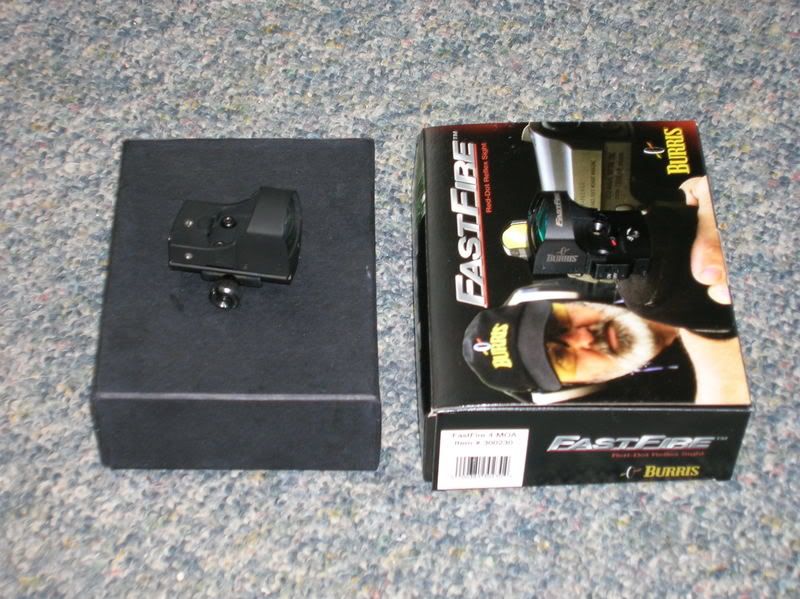
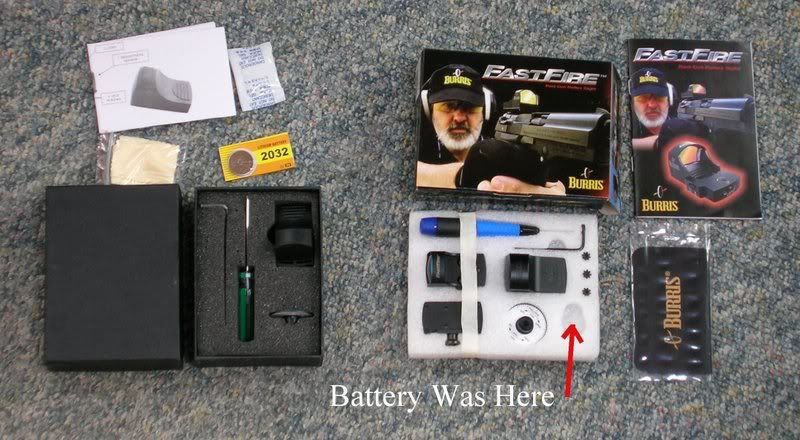
Lone Wolf and Burris FastFire Mini Reflex Sights

I got the Lone Wolf red dot sight (catalog number: LWD-RDS) first. Testing it out, I quickly discovered that it was really hard to find the dot when aiming at a light colored targets that was brightly lit. The dot also flares pretty bad in twilight.

I read a few short reviews on the Burris FastFire red dot, a similar micro reflex sight. As I write this, the sights are hard to come by, and feedback on them is pretty hard to find, although most of what I found was positive. Finding that Natchez had them available, I placed an order for a FastFire, a Glock slide mount for the sight, and while I was at it, ordered a few $15 Glock factory magazines.

The two sights are very similar, and both share more than a little in common with the Docter Optic sights, now imported by Trijicon. There are reports on the internet that the FastFire works on Docter mounts and vice versa, although the screw threads are different. I tried the FastFire on the Lone Wolf base, and vice versa. Again, except for different screw threads, the sights are interchangeable. The JPoint is a different animal, and the screw holes are in a different location altogether.

Construction wise, the sights are pretty much the same. The main body of the sights seem to be cast aluminum with the hood being a piece of aluminum sheet. The lens, or window, or whatever you want to call it is glass on both, not plastic like in the JPoints. The FastFire has a magnet that holds the battery in place, which is handy and lacking on the Lone Wolf sight. The adjustment bar, for lack of a better term, on the Lone Wolf sight appears to be a more roughly cast part than on the Burris sight, which seems to have a machined adjustment bar. The electronic bits of the FastFire are more securely glued in place than in the Lone Wolf sight. I’m not saying that anything is floating around loose in the Lone Wolf sight, only that the Fast Fire might be more recoil resistant.

(Sorry, my camera won't focus on the dots. LWD-RDS on left, FastFire on right.)

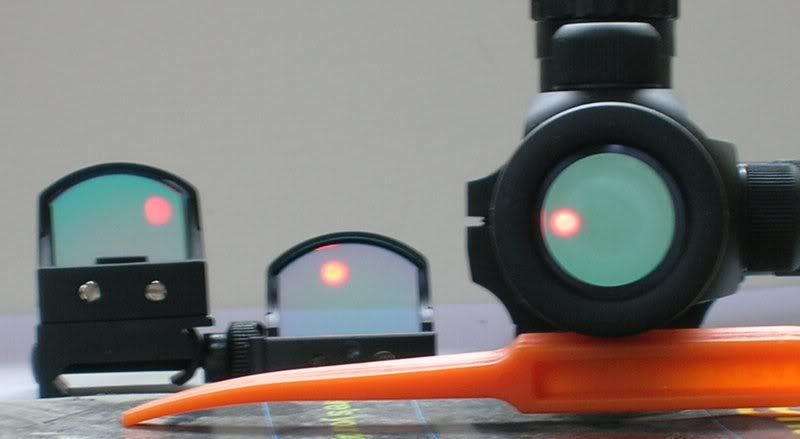
(Lone Wolf Red Dot on left, FastFire in the Middle, Tasco PDP2 (30mm tube, 5MOA Dot) on right)

Sitting the Lone Wolf and FastFire side-by-side, the FastFire is noticeably brighter, which is what I was after. The FastFire dot still flares a bit in low light, but being brighter, the dot is much easier to find. Although the Lone Wolf sight is advertised to have a 6MOA dot, it appears to be exactly the same size as the FastFire 4MOA dot.

For my purposes, the FastFire is the better product. To be fair to Lone Wolf, Burris only offers a one-year limited warranty, and the Burris sight costs twice as much. The Lone Wolf sight works pretty damn well indoors, but would not work as well for sunny outdoor or low-light matches. Although I could have used the Lone Wolf RDS on one of several plinkers, or put it on the airsoft Glock to train with, ultimately I needed the $80 back more.

For the price of an unmodified Docter Optic mini-reflex sight, you could buy 5 or 6 Lone Wolf red dot sights. For the price of a (plastic) JPoint, you could buy 3 of the metal and glass Lone Wolf sights. Neither of the more expensive sights is particularly bright either, except for the Docters modified by Beven Grams of Grams Engineering, and the modification costs another 1.5 times the price of the Lone Wolf.
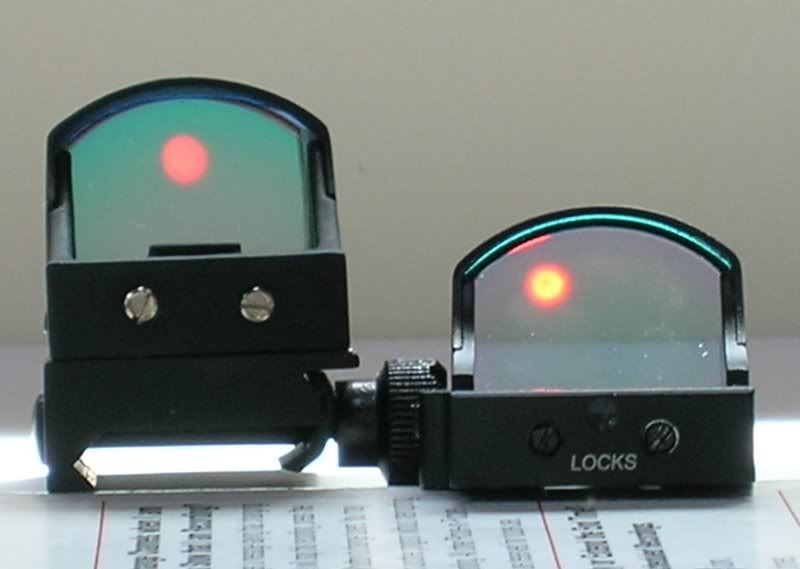
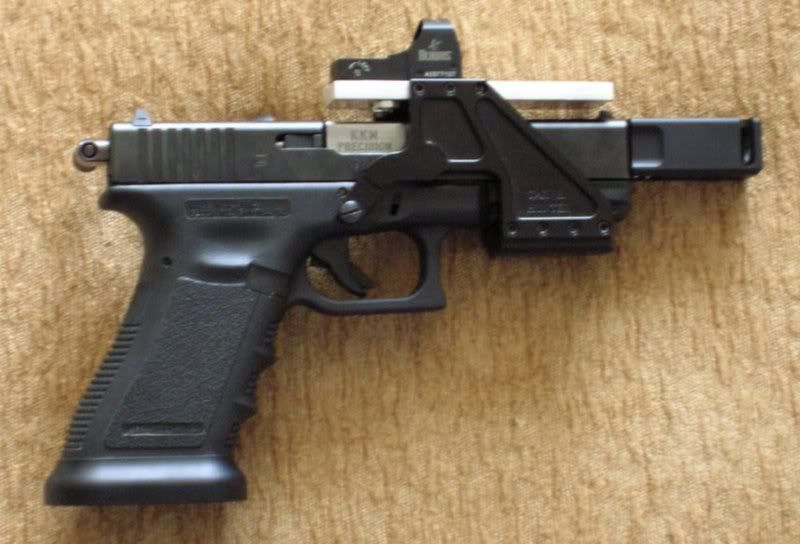
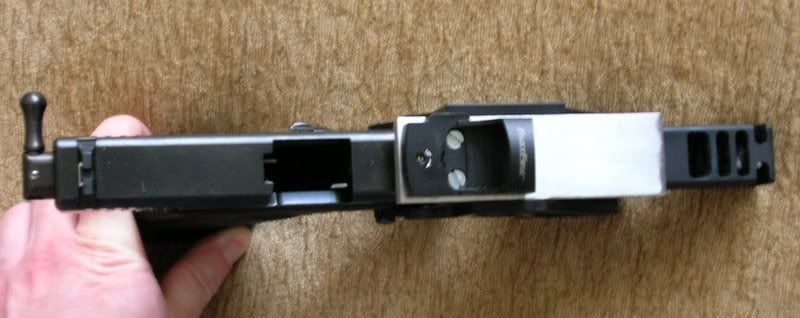
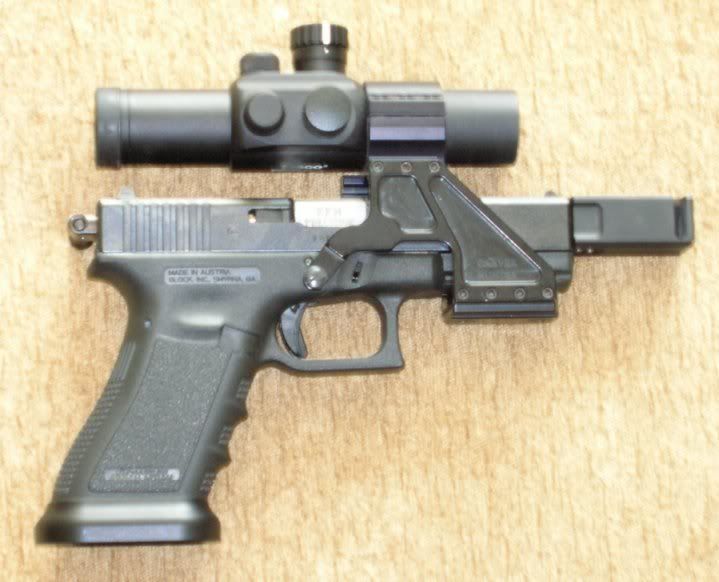
Pictures of the FastFire mounted on a Glock are of my racegun, as it currently stands. It is a Glock 17 with a Carver Hunter mount and a top plate that I cut from 1/4" thick aluminum. The whole point of fiddling with the slide-ride optic was to get a red dot scope small enough that I could mount it forward of the ejection port where it wouldn't interfere with ejection and get beaten up by the reciprocating slide.

Live Fire Testing
I had a little trouble sighting it in at first. A couple times I forgot to unlock the adjustments, which put me way off in the wrong direction. Once I figured out what I was doing wrong, it wasn't long before I was shooting out the X-Ring at 50 feet.

For a while, I had trouble finding the dot, and had put a pin at the front of the mounting plate, which I used to help find the dot. After a little practice with the new set-up, I found that I wasn't using the pin anymore, and have since removed it. I will cut the mounting plate down to match the front of the scope mount eventually.

The adjusting wheel that fits over the shaft of the screwdriver makes it pretty much impossible to see where you're putting the blade. I'm thinking about drilling a few holes in the wheel, but I'm a little concerned that I'll then end up breaking the plastic wheel in my gear bag.

My RaceGun with the PDP2 before I got the FastFire set-up

UPDATE: I've noticed the dot getting really dim now and then. After firing a shot it gets back to full brightness. After the last outdoor match of the season, I'll call Burris and see if there's a fix.

UPDATE, AGAIN: Got to poking around on the internet, and discovered that others were having the same problems with the dot fading out randomly, and then coming back after firing a shot. Putting a piece of rubber band between the mount and battery seems to be a half-assed, although effective solution.

Sunday, December 23, 2007

Scope Adjustment Program for TI Graphing Calculators

I wrote this program for use on a TI-83. I'm not sure if it will work as written on newer models. You input the range, the click values for your scope, and how many inches you need to move the impacts, and it spits out the number of clicks. Works good with high quality scopes, but the click values for cheaper scopes don't always turn out to be exactly what the manufacturer says they are.

Notes are in italics, you do not need to program the notes, and you probably couldn't if you tried. "clrhome" commands are optional, but I think it makes a cleaner running program. If you can manage to add to the program so that it rounds the click adjustment number (B, in this program) to a whole number, I'd like to know how you did it.

clrhome
disp "ENTER RANGE"
disp "IN YARDS"
prompt R
clrhome
disp "CLICK VALUE" These lines determine scope adjustments
disp "4 FOR 1/4" Typical hunting/plinking scopes have 1/4 MOA adjustments
disp "8 FOR 1/8" Target scopes have 1/8 MOA adjustments
prompt C
clrhome
disp "ENTER ADJUSTMENT" If you are off to the left (or right, up or down) by three inches, type "3" then "enter"
disp "IN INCHES"
prompt A
clrhome
(100/R)*C*A->B Push "STO" button next to the "1" button to get "->" arrow
disp B
disp "clicks to adjust"
disp A
disp "inches at"
disp R
disp "yards"

Tuesday, December 11, 2007

Tasco PDP2 Red Dot Scope


My first experience with a red dot sight was a BSA that I bought for around $30. It really wouldn’t hold a zero, and the dot completely washed out in bright sun. It was okay for indoor pistol ranges, if you could co-witness it with iron sights. Outdoors, or without iron sights, it was a headache.
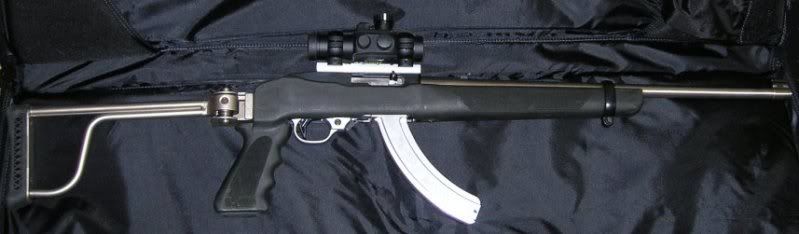
Although I’ve had a few bad experiences with Tasco/BSA optics, I bought a PDP2 for Ruger Mk.II based on a handful of good reviews. That one worked out well, so I bought two more.

The one that I’ve used the most is mounted on a Glock 17 race gun. Despite being pelted with brass enough that some of the finish has worn off the bottom, is still holds a zero pretty well, as long as the mount and ring screws are kept torqued.

The dot is medium sized at 5MOA. Reasonably good for accuracy, and for speed. A bigger dot would be better for action shooting, but it’s still faster than trying to line up the front sight, rear sight, and target. An 8MOA dot would be better for action shooting.

Brightness settings are good on this scope. I’ve used it in dark indoor pistol ranges, and outside in bright sunlight, without any problems. I had a little trouble with the dot fading away at random times. I accidentally pulled the spring out of the battery compartment cap trying to stretch it out. It still works, and I haven’t had the dot disappear since.

The sight uses 2 357-type batteries, commonly used in lasers and digital calipers. The batteries are available in Wal-Mart stores in 3-packs at a reasonable price, as well as in most drug stores. Although I haven’t kept track of battery life, they will last a dozen or so hours, at least.

With the included sunshade screwed in, the scope can be mounted with a single wide ring, like an Aimpoint. As an added benefit, the sunshade helps keep powder fouling, thrown up and back, off of the objective lens, when mounted on a compensated or ported pistol.

Monday, September 3, 2007

Carver Hunter Mount Review


I bought one of the Carver Hunter mounts for a 30mm tube scope about a year ago for my Model 17. With the proper recoil spring and some threadlocker on the screw that replaces the trigger pivot pin, the mount works great.

With the factory recoil spring, the brass was going straight up, bouncing off the scope, and sometimes getting stuck between the breechface and barrel resulting in what looks like a stovepipe failure. I found that a Wolff 14 pound recoil spring on an aftermarket guide rod solved this problem. With an SJ Custom 9mm Major compensator, a 10 lb ISMI spring for a 1911 (only use with reduced power firing pin spring), coupled with a Glock factory ejector for a .40 S&W pistol worked (EDIT: worked fairly well, not quite 100% reliable). These spring and ejector changes result in the ejected brass going out under the scope, without any jams (EDIT: not quite). My slide is not modified, no enlarged ejection port.

Without using threadlocker on the screw that replaces the trigger pivot pin, the point of impact slides to the right as the screw loosens under recoil.

Although not really a functional modification, I've found that the Mako slide racker, that replaces the slide cover plate, makes using the pistol a lot easier, and probably helps keep me from knocking the scope as I unload the pistol. The other screws seem to stay put.

Now that I've got the springs and threadlocker thing figured out, I don't have any problems with the mount, even without the ejection port modification. With the red dot scope, I'm shooting much faster and more accurately that I can shoot the same pistol with iron sights.
Carver Web Site